
What Is Creosote and Why Does It Matter for Fire Risk?

You’re settling in for a quiet evening in front of the fire when a fine dusting of dark flakes drifts down onto the hearth. Most Portland homeowners glance at it, sweep it up, and think nothing more of it. But those flakes are creosote, and how much of it has built up inside your flue matters more than most people realize.
Creosote is a black or brown residue that forms when wood smoke cools and condenses against the inside of a chimney flue before it can fully escape. It’s made up of unburned combustion byproducts, tar, and soot, and it’s highly flammable. Unlike ordinary ash, creosote clings to masonry and metal liners, building up layer by layer with every fire you burn. Left alone, it doesn’t just make a chimney dirtier. It turns the flue itself into fuel.
That’s the distinction worth noting. Creosote is a fire-safety issue, and Portland homeowners who neglect it tend to catch problems too late.

The Three Stages of Creosote in Brief
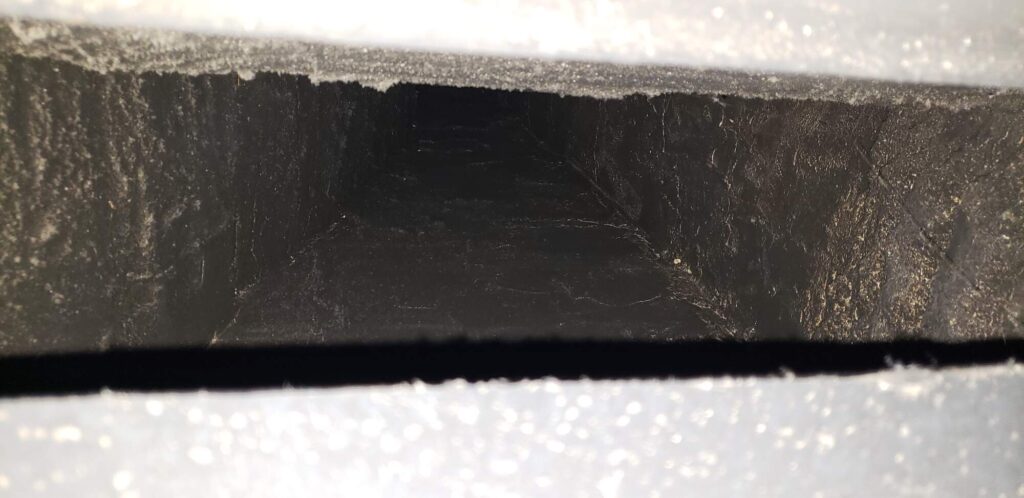
Creosote develops in three recognized stages, and we see all three on Portland chimneys year-round. Stage 1 is flaky and sooty, easy to remove with routine sweeping. Stage 2 turns crusty and tar-like, harder to brush away and quicker to ignite. Stage 3 is the most flammable form, with a glazed, shiny, hardened coating, and calls for professional removal regardless of how thick it looks. If you want to see what each stage actually looks like, read our full creosote stages guide for the full breakdown.
How Does Creosote Cause a Chimney Fire?
A chimney fire doesn’t need a spark from outside to get going. Creosote is the fuel, and once it ignites inside the flue, it feeds on itself in a way that catches most homeowners off guard.
Creosote, particularly highly concentrated Stage 3 glazed creosote, can ignite at around 1,000 degrees Fahrenheit. Once a chimney fire begins, however, temperatures inside the flue can rapidly climb past 2,000 degrees Fahrenheit.
That extreme heat can exceed what a chimney system is designed to endure. Clay tile flue liners can crack under the sudden thermal stress, while metal liners may warp or deteriorate. If the liner becomes compromised, heat and flames can reach nearby combustible framing and turn a contained chimney fire into a structure fire.
This is where things turn structural. Sudden, extreme heat can crack clay tiles, warp metal liners, and stress surrounding masonry through rapid expansion and contraction. Once a liner is compromised, heat and flame have a more direct path to the wood framing that runs alongside most chimneys, especially where they pass through an attic or roofline. A contained flue fire is dangerous. A flue fire that breaches its liner is a structure fire.
This isn’t a rare, hypothetical scenario. According to the Chimney Safety Institute of America, more than 25,000 residential chimney fires are reported across the U.S. in a typical year, and creosote buildup is the common thread running through most of them. For any Portland homeowner weighing how seriously to take an annual sweep, that’s the number that answers the question.
If it’s been a while since your flue was checked, don’t wait for the smell of smoke to make the decision for you. Request a Free Estimate and we’ll take a look before your next fire.
Creosote Doesn’t Just Cause Fires. It Can Poison Your
Home Too.
Fire is the obvious danger, but it isn’t the only one. As creosote builds along the walls of the flue, it narrows the passage that smoke and combustion gases, including carbon monoxide, need to escape through.
A partially blocked flue doesn’t necessarily stop working. It just works less efficiently, and that’s actually the more dangerous scenario. Gases that should be venting outside can back up into the firebox and, from there, into the room. Carbon monoxide is colorless and odorless, so a restricted flue can be quietly pushing it into a living room for weeks before anyone notices anything wrong.
Homeowners often assume a working chimney means a safe one. But a flue can draft well enough to keep a fire burning while still restricting exhaust badly enough to push carbon monoxide back indoors. Portland’s older homes, many built with narrower, less-efficient flue systems, are especially prone to this slow restriction as creosote layers build year over year. A working carbon monoxide detector near any fireplace or wood stove matters as much as the fire risk itself. It won’t stop creosote from forming, but it will tell you when airflow has become a problem long before you’d notice on your own.
Why Portland Homeowners Face Elevated Creosote Risk
Creosote forms fastest when wood burns cool and smoky instead of hot and clean, and Portland’s climate makes that harder to avoid than most homeowners expect.
Portland gets roughly 36 to 40 inches of rain a year, and that moisture doesn’t stay outside. Firewood left uncovered, or stacked directly on wet ground or concrete, soaks up ambient moisture right along with the season. Damp wood burns cooler, smolders more, and sends more unburned particles up the flue to condense as creosote. It’s a straightforward chain reaction, and it starts with how the wood is stored, not how the fire is built.
Local housing stock adds another layer of risk. Neighborhoods like Irvington, Laurelhurst, and Alameda are full of older homes with chimneys that were never lined, or that were lined with clay tile decades ago. Many of these systems predate modern standards, and retrofitting one with a liner isn’t always the improvement it sounds like. A liner that’s too thin or poorly insulated can leave a worse heat barrier than the older masonry it replaced, particularly in a historic Portland home built around an original Victorian chimney. If that description fits your house, damaged liners need professional replacement evaluated by someone who measures the flue and matches the liner to the system, rather than installing whatever’s on the truck.
Species matter too. Douglas fir, one of the most common firewoods in the Portland area, needs 9 to 12 months of proper seasoning to drop below the 20 percent moisture threshold considered safe to burn. Red alder seasons faster, often in under a year. Oregon white oak is denser and takes longer, typically 18 to 24 months, and burning it before then means feeding the fire with wood that’s still working against you. The EPA seasoned firewood moisture guidance puts the safe threshold at 20 percent moisture or below, and an inexpensive moisture meter is the only reliable way to know where your wood actually stands.
Does Rarely Using Your Fireplace Keep You Safe?
It’s tempting to assume a fireplace you rarely light poses less risk, but the opposite is often true.
Occasional fires are more likely to be built with whatever wood happens to be on hand, rather than wood chosen and seasoned for the purpose. A fire lit only a few times a season is also more likely to smolder while everyone gets the flue drafting properly again. Add in a chimney that’s gone unchecked between uses, and infrequent burning can carry more creosote risk than a fireplace used every week by someone who’s dialed in their routine.
What Multnomah County’s Burn Restrictions Mean for
Your Chimney
Multnomah County uses a Yellow and Red advisory system to manage wood smoke across the Portland metro on days when air quality is a concern, and the same conditions that trigger those restrictions tend to be the ones that build creosote fastest.
On a Yellow day, the guidance is to consider limiting burning. On a Red day, burning is prohibited outright for wood and pellet stoves, fireplaces, fire pits, and chimineas, with restrictions taking effect by noon the day they’re issued. Portland saw this play out directly in January 2026, when the county issued a mandatory Red Day during an air-stagnation advisory that trapped smoke close to the ground across the metro area.
Exemptions exist for households where wood or pellet heat is the sole heat source, for households at or below 60 percent of Oregon’s median income, and for a temporary 120-day exemption when a power or heating-system failure leaves no other option. All exemptions expire Sept. 30 and have to be renewed annually, so it’s worth checking your status each fall rather than assuming last year’s exemption still applies.
You can check current status any time through the Multnomah County wood-burning restrictions page, Oregon DEQ air quality advisories, or check current air quality conditions directly. For faster notice, the county also offers a free text alert: text START to 503-994-2876, and advisories will come straight to your phone.
The connection back to your Portland chimney is direct. The still, damp, stagnant air that triggers a burn restriction is exactly the kind of weather that makes wood burn cooler and smolder longer indoors, which is precisely when creosote builds up fastest.

How to Reduce Your Chimney Fire Risk
Most creosote risk comes down to a handful of habits, and Portland homeowners can control nearly all of them.
- Burn only seasoned wood at or below 20 percent moisture. Damp wood is the single biggest driver of creosote buildup, and a moisture meter is a small cost against that risk.
- Store firewood covered and off the ground. A tarp over the top and a rack or pallets underneath keep Portland’s rain from working its way back into wood that’s already seasoned.
- Never restrict airflow or dampers to make wood last longer. Choking off air to a fire only makes it burn cooler and smokier, which builds creosote faster instead of slower.
- Schedule an inspection and cleaning every year, regardless of how often you use your Portland fireplace. NFPA 211 calls for chimneys, fireplaces, and vents to be inspected at least once a year for soundness, freedom from deposits, and correct clearances, and that standard doesn’t carve out an exception for a fireplace that’s only lit a few times in winter.
The first three steps are yours to manage. The fourth is where professional chimney cleaning removes creosote that’s already built past the point a homeowner can safely handle, particularly once it reaches Stage 2 or Stage 3.
If you’ve been putting off that annual check, Request a Free Estimate and we’ll get a sweep on the calendar before your next fire.
How a Professional Inspection Finds the Risk You Can’t See
Everything above explains why creosote is dangerous. The harder question is figuring out where your own Portland chimney actually stands, since most buildup happens several feet up a flue no homeowner can safely check alone.
That’s exactly what a Level 2 inspection is built to answer. It includes video documentation of the flue, so instead of taking someone’s word for what’s inside, you see the creosote stage and liner condition on screen. We walk through that footage with you afterward, so you know exactly what we found and what it means for your chimney before any work begins. If it’s been a year or more since your last check, schedule a Level 2 inspection and get that clarity for yourself.
We’ve spent over 40 years working on Portland chimneys, and every estimate we give is transparent, with no surprise charges once the work is underway. Request a Free Estimate and let’s find out exactly where your chimney stands before the next fire.
Frequently Asked Questions
What does creosote look and smell like?
Creosote starts out flaky and dark, similar to soot, with a sharp, sooty smell that’s often noticeable near the fireplace even when it isn’t in use. As it progresses, it turns crustier and more tar-like, with a stronger, almost sour odor. In its most advanced, glazed stage, it can look shiny or bubbled and often carries the strongest smell of the three stages.
How much creosote buildup is dangerous?
The Chimney Safety Institute of America points to one-eighth inch of buildup as the widely cited threshold for needing a professional sweep. Glazed, Stage 3 creosote is the exception. It warrants attention regardless of thickness because it’s the most flammable form and ignites more easily than the flakier early stages.
Can a small chimney fire happen without me noticing?
Yes, and it happens more often than most Portland homeowners assume. A slow-burning chimney fire can sound like a low roar or crackling from within the flue, or produce a stronger-than-usual smell of hot creosote, without ever producing visible flames. These quieter fires still reach damaging temperatures and can crack a liner even if no one sees them happen.
Do I still need an inspection if I barely use my fireplace?
Yes, since infrequent use doesn’t reduce creosote risk the way most people expect, and occasional fires are more likely to be built with unseasoned wood and to smolder while getting going. NFPA 211 calls for an annual inspection regardless of how often a chimney is used, and that applies just as much to a fireplace lit twice a winter as one used weekly.
Does Multnomah County’s burn ban mean my chimney is unsafe?
Not directly, since a Red Day restriction is about regional air quality, not the condition of your specific chimney. That said, the still, damp weather that triggers these advisories is also the weather that makes wood smolder and creosote build up fastest, so it’s a good prompt to check when your chimney was last inspected.
How often should I have my chimney cleaned in Portland?
Most Portland homes need a professional cleaning at least once a year, in line with NFPA 211’s annual-inspection standard, though homes that burn often or use less-seasoned wood may need it sooner. An inspection tells you exactly where your creosote stands rather than leaving it to guesswork.
